
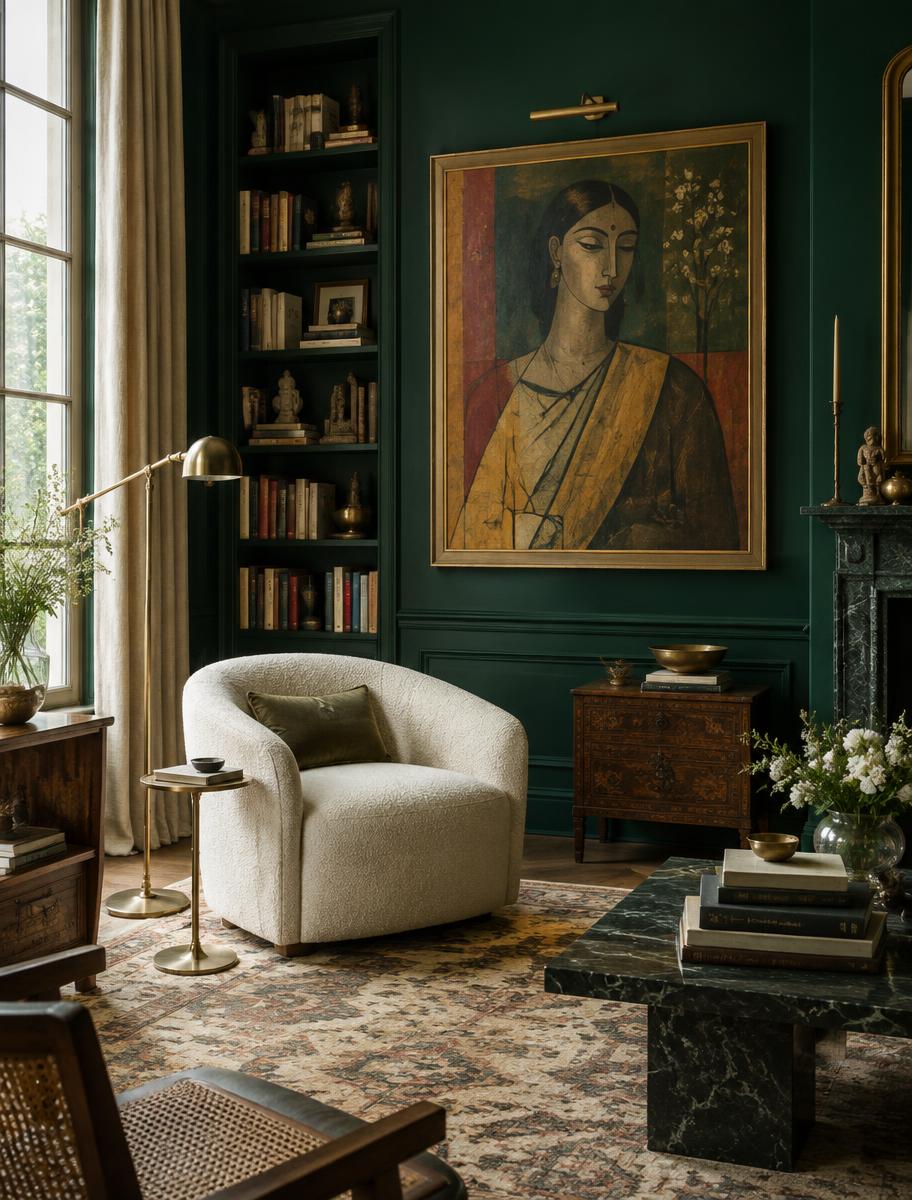
Galleries show art on white walls, in even light, with space all around. Homes are different: they have colour, furniture, windows, children and memories. The art that we live with must find its place among all of this, and when it does, it becomes more alive than any gallery could make it.
Choose the wall before the work
Consider where a painting will be seen most often: across the dining table, from the sofa, at the turn of a stair. A large canvas needs distance to breathe; an intimate miniature wants to be seen from a step away, perhaps in a study or beside a reading chair.
Let colour converse
Deep walls, emerald, oxblood or ink, can make gilded frames and rich pigments glow. Warm neutrals suit quieter, abstract work. The goal is not to match the art to the room but to let the two speak to one another.
“A great work of art does not decorate a room. It gives the room its centre.”
Mix eras with confidence
Some of the most beautiful interiors pair a modern master with an antique chest, a bronze with a stack of well-read books. Mixing eras shows that a collection is personal rather than assembled, and it lets each piece be seen afresh.
Light and care
Keep works away from direct sunlight and sources of heat or damp. Use warm, indirect lighting; picture lights or discreet ceiling spots angled at around thirty degrees reduce glare. Hang paintings with their centre at roughly eye level, around 150 cm from the floor, and group smaller works tightly so they read as one.
Begin a conversation
If you are unsure how a work will feel in your space, ask us. Our advisors can share scaled visualisations of works in your room and guidance on framing and placement before you acquire.