An Indian miniature is not meant to be glanced at. It was made to be held in the hand, turned towards the light and read slowly, often aloud with poetry, among a small circle of connoisseurs. To look at one well, we must borrow a little of their patience.
Begin with the border
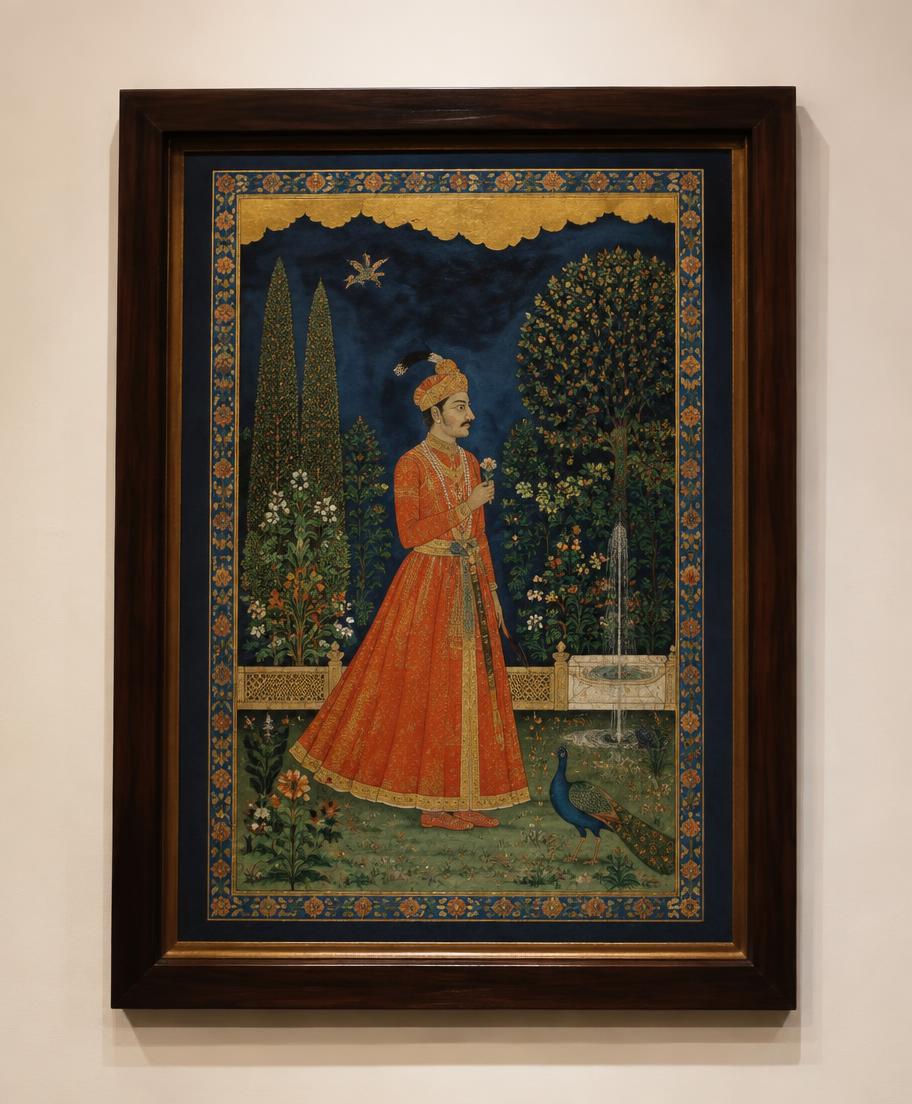
The border tells you where you are. Mughal albums favoured wide margins of flecked gold and delicate floral scrolls; Rajput schools often used bold red or yellow frames. The border is a threshold: step across it, and you enter a world with its own rules of time and space.
Read the landscape
Space in a miniature is not Western perspective. Multiple viewpoints coexist: a terrace seen from above, a figure seen from the side, a sky that rises like a wall. Gardens are divided into ordered quarters, the charbagh, an image of paradise. Water, fountains and cypress trees speak of abundance and eternity.
“Nothing in a miniature is accidental. A flowering tree, a storm cloud, a pair of birds: each is a line of the poem.”
Watch the gestures
Hands carry the story. A raised finger may signal speech or wonder; a hand at the chin, longing. In paintings of lovers, the heroine's posture, turning away or leaning in, expresses one of the many moods catalogued in classical poetry. Storm clouds and lightning frequently mean separation; a moonlit terrace, union.
Look at the colour and the hand
Pigments were ground from minerals and plants: lapis for blue, malachite for green, and gold beaten and burnished. Examine the fineness of the brushwork in faces and textiles, where the finest ateliers used brushes of only a few hairs. Condition, clarity of pigment and quality of line are what distinguish a court masterpiece from a later copy.
For the collector
Ask about provenance, school and period, and view the work unframed if possible. A trusted advisor can help you distinguish original court work from later revival painting, both of which have their place in a collection, at very different values.